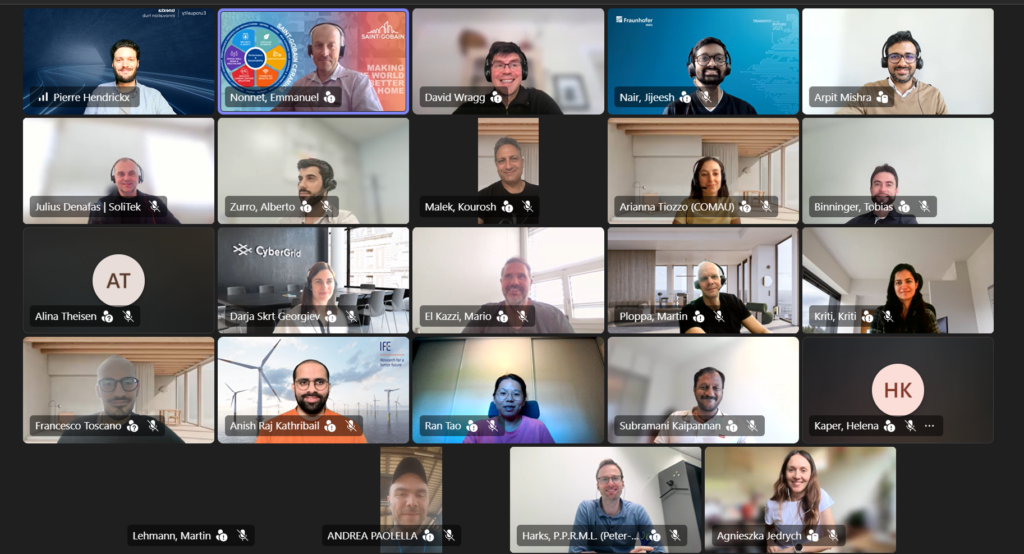
On Tuesday 16th June 2026, a consortium meeting of the SPRINT project took place to conclude project’s first stage.
Consortium members representing all 18 partners convened online this time to reflect on the first part of the project, our current position on the workplan timeline, and a preview of the project’s second stage.
We mainly focused on Work Package 2 (Refining of materials at lab-scale) and Work Package 3 (Cell optimisation, in-depth characterisation, and modelling for rapid final chemistry selection) [1], as well as the appointment of the project’s Exploitation Board [2].
Assessing progress to date
Indeed, in the first part of the consortium meeting, the respective Work Package Leaders (WPLs) presented the progress achieved over the first 18 months. WP2 focused on the development and optimisation of key battery materials required for the next generation of sustainable and safe sodium-ion batteries.
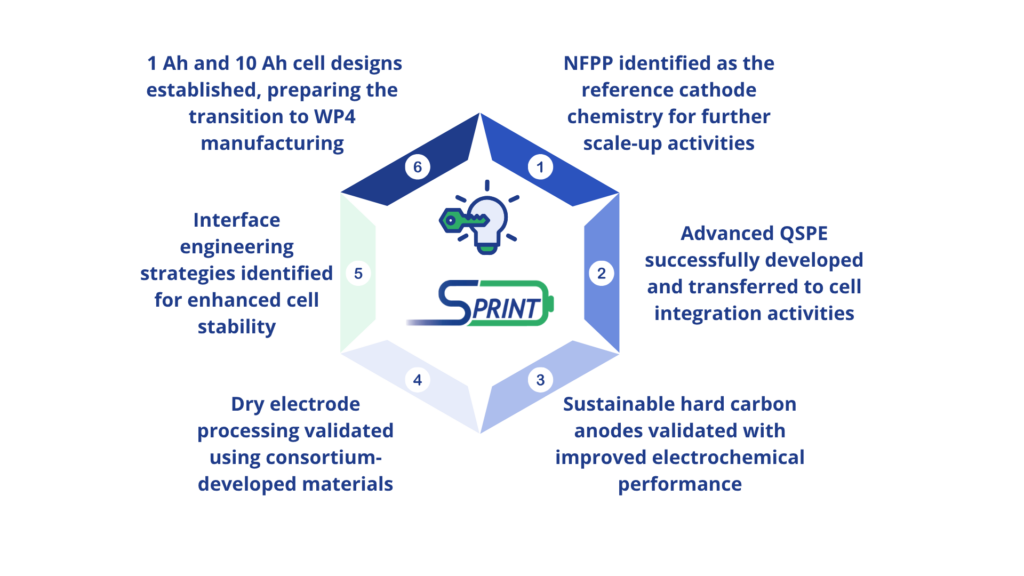
Overall, WP2 successfully established the material foundations required for the subsequent stages of battery development. Despite considerable efforts, to make the NFP candidates work, exploring several avenues for improvement, the results were not satisfactory. Thorough technical assessment identified NFPP as a more robust cathode candidate. Moreover, the successful transfer of advanced quasi-solid-state polymer electrolyte formulations to cell development activities, along with the validation of high-performance hard carbon anodes, constitute major achievements of the project’s first period and provide a solid basis for the optimisation and demonstration activities planned in the upcoming periods.
WP3 focused on bridging the gap between material development and battery prototyping by establishing the technological and engineering foundations required for future cell manufacturing and system integration.
A major focus of WP3 was the preparation of the project’s scale-up pathway through the definition of pouch cell and battery system designs. Building on the material developments and cell chemistry selections made throughout the project, detailed specifications were established for both 1 Ah and 10 Ah pouch cells, including electrode compositions, binder systems, cell geometry, and electrolyte configurations. In parallel, engineering activities addressed the design of complete battery systems, covering cell architecture, module integration, thermal management, structural layouts, and safety considerations, including venting units.
By consolidating these elements into a coherent design framework, the consortium created a roadmap that will guide prototype manufacturing in WP4 and support the transition towards large-scale battery validation and demonstration.
Building on the WP3 activities, WP4 was officially launched during the CM. It will focus on the upscaling towards demonstration of pouch cell prototypes and the assembly of the batteries. Partners had the opportunity to discuss this upcoming stage at the end of the morning session.
Introduction of the Exploitation Board
At the beginning of the afternoon session of the CM, the Exploitation Board candidates were invited to a roundtable discussion where they had the opportunity to introduce themselves. The project partners showcased their existing achievements to them, as well as the future objectives on which SPRINT will focus in the coming months. A dedicated Questions and Answers session with the Exploitation Board (EB) candidates was held as well.
At the moment, the EB has 13 members. This number will increase in the upcoming months as the project further evolves.
The EB gathers potential end-users, policymakers, and investors who will help ensure the alignment of the batteries with industrial requirements, including in other applications with similar needs. As such, they will support the commercialisation uptake of solutions developed within SPRINT.
SPRINT’s next steps
The next phase of the SPRINT project is dedicated to bridging the gap between laboratory validation and demonstration readiness, with a clear focus on scale-up, process robustness, and manufacturability of sodium-ion battery components. This phase will prioritise the scale-up of selected electrode materials. A central objective of this phase is the development of pre-industrial cell prototypes integrating scaled materials, enabling the first validation of manufacturability at relevant format and throughout.
Dissemination and exploitation activities will run in parallel, supporting visibility, stakeholder engagement, and the progressive positioning of project outcomes within the industrial ecosystem.